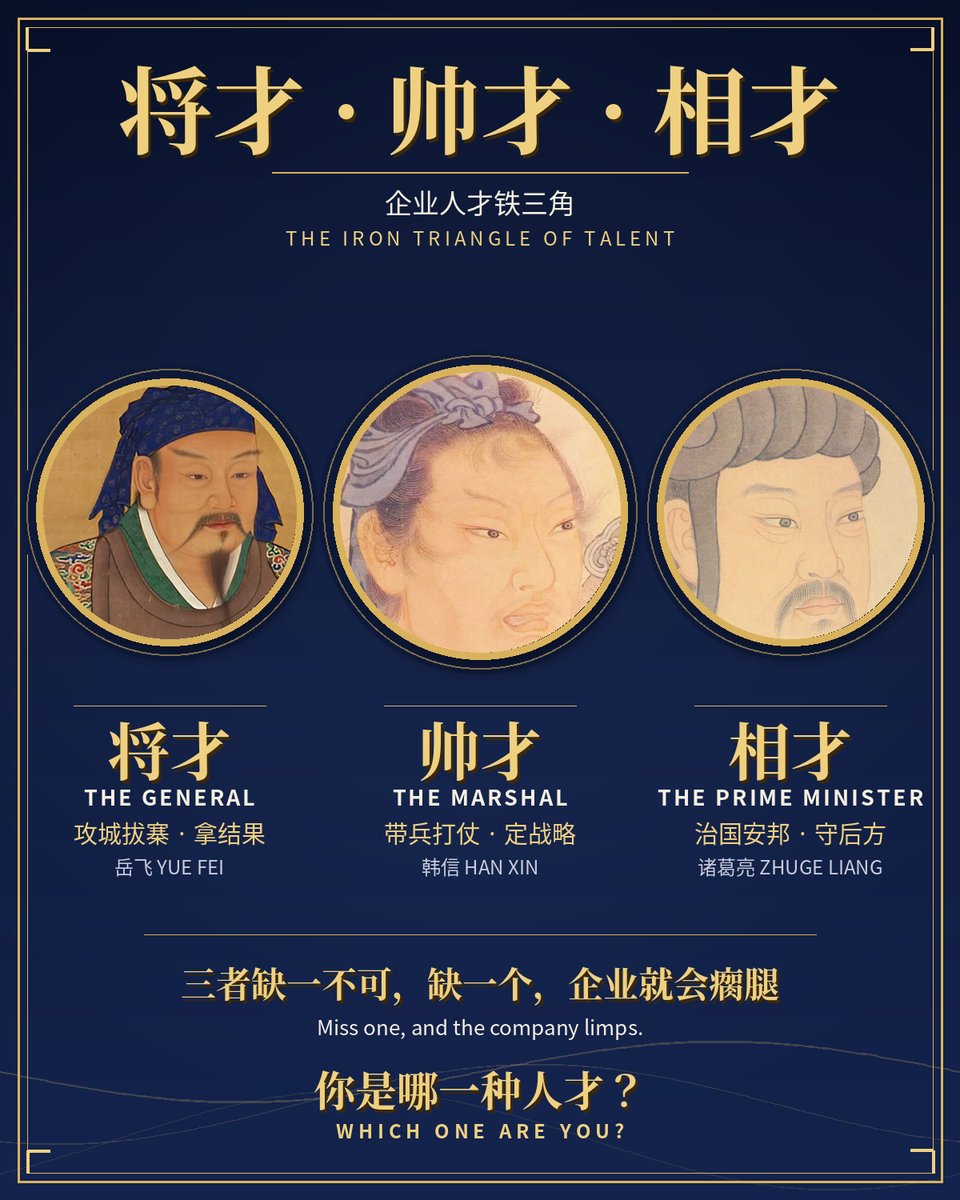
There is an old Chinese framework about talent that I keep coming back to. It maps onto modern business better than most Western management models I have read.
Every company runs on three types of talent.
The General (将才). The one who storms cities and delivers results. Strong execution, deep professional authority. The tougher the battle, the more energised they get. Your sales champions, operations experts, production chiefs. In plain terms: people who get things done.
The Marshal (帅才). The one who commands the army and sets strategy. A General is personally brilliant. A Marshal makes an entire group brilliant. To a Marshal, everything is a board: which battle to fight, why, who fights it, and how. They put the right people in the right seats, and they hold the team's confidence under pressure.
The Prime Minister (相才). The one who governs the state and guards the rear. Administration, finance, HR, legal, compliance, systems, process. This work rarely generates revenue directly. Without it, the company cannot survive, let alone scale.
Three roles. All indispensable. Miss one, and the company limps.
The most common (and most expensive) mistake
Promoting a General into a Marshal's seat.
I once watched an e-commerce operations director who personally carried close to half the company's revenue get promoted to Vice President over the whole operations team. Within six months, half the team had left and revenue had dropped 30%.
He could execute at 100 points himself. But when leading others, his default response was: "Why are you all so slow? Watch how I do it." Then he took the work back. The team never grew. They just felt undervalued.
Sales lost a top performer. The company gained a mediocre boss.
Hard skills get you promoted. Soft skills decide whether you survive the promotion. A sales head negotiates deals. A C-suite executive negotiates funding, talent and organisational design. Same verb. Completely different game.
What a real Marshal does
A Marshal does not need to be the best technologist, the best salesperson or the best operator.
Ren Zhengfei is the classic example. The founder of Huawei does not personally do the technology, the sales or the finance. He gathers strong people, points them in one direction, sets the rules of the game, and keeps a workforce of over two hundred thousand moving as one.
That is Marshal ability: building a team that behaves like a single organism. A company without one is a pack of lions with no head. Each fights its own battle. Today they charge east, tomorrow west. The harder they work, the more lost they become.
The quiet power of the Prime Minister
If Marshals conquer new ground, Prime Ministers make sure the realm can actually be governed.
Look behind almost any durable large company and you will find one:
Joe Tsai at Alibaba: co-founder, long-time CFO, now Chairman
Martin Lau at Tencent: President since 2006, running day-to-day operations
Sun Yafang at Huawei: Chairwoman for nineteen years, until 2018
Their work is rarely glamorous. Remove it, and the front line collapses the moment the business is pushed hard.
I have seen the opposite far too often. A driven founder opens 20 stores in three years. Revenue looks fantastic. Then in year four the company implodes. Nobody was tracking which stores actually made money. The supply chain was chaotic. Cash flow was a black box. There was no talent pipeline.
The front line ran too far ahead. The back office could not keep up. One hard push and everything fell over.
If you are climbing the ladder
The first step is not upward. It is inward.
Are you a General, a Marshal or a Prime Minister? And what do you want to become? If you are aiming for the C-suite as a Marshal, you have to deliberately build Marshal skills. The same goes if your path is the Prime Minister's. Titles do not transform people. Capability earns titles.
If you are struggling at the level you are aiming for, ask a harder question: do my ambition and my strengths actually match?
If you are building a company
Most founders are exceptional executors. Generals, through and through. Far fewer know how to attract talent and organise a team.
Here is a belief worth challenging: talented people follow money. Often they do not. Smart people follow leaders who give them a platform where they feel genuinely useful, and who show real appreciation.
It is also why investors fund only a select few startups. A great idea without a cohesive team is just a nice presentation.
Now flip it. You are well funded and can hire freely. Does that guarantee success? No. Money raises your odds. It cannot replace judgment, and it cannot replace structure. A company with no Prime Minister cannot scale. If it cannot scale, why should an investor's capital wait while you figure it out?
The real prerequisite
Too many people leave corporate life to strike out alone and end up worse off. They had plans. They did not have the mindset.
A real entrepreneur is a person of clarity. They know what the business is, why they are building it, and which role they actually play: the General who executes, the Marshal who directs, or the Prime Minister who holds it together.
So the sequence matters.
1. Build your mindset.
2. Then your plans.
3. Then your team.
The rest follows.
In plain terms: every business needs people who get things done, someone who leads those people, and someone who keeps the machine running behind them. If one of the three is missing, it shows up as burnout, chaos or a stall. Usually all three.
Which one are you? And more importantly, which one are you becoming?
If you run a business and want to see which of the three is thin in yours, the Operational Readiness Diagnostic at jordanng.sg takes a few minutes and tells you where the gaps are.